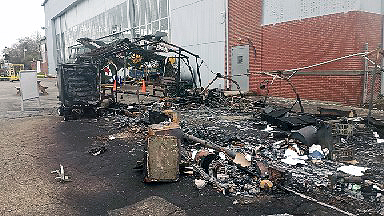
The MAPS Air Museum, located in North Canton, featured a Vietnam-era field hospital that was destroyed in a fire Nov. 3. The investigation is still ongoing, therefore the cause of the fire has yet to be determined. There are plans to rebuild the field hospital, however, only a handful of items from the field hospital are able to be restored.
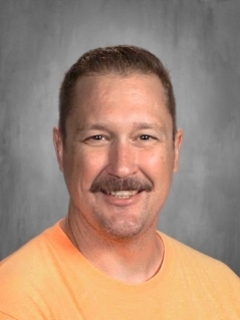
The field hospital was built by Mr. Ted Mathies. He was a field medic in Vietnam and has remained dedicated to sharing history about what life was like when he served. He accomplished this with the display, which was an accurate representation of what a medical tent looked like in Vietnam, with 99% of artifacts being originals, not replicas. He spoke about his reaction to finding out that the medical tent he’d dedicated a remarkable amount of time and energy running, had caught on fire.
“I won’t say shock, but [it’s] not what most people think,” he said. “This would actually be the third aid station that I’ve been involved with that’s been destroyed. Two of them were in Vietnam. Vietnam taught me that nothing is permanent.”
Education Director Mr. Jerry Patton, reflected on what his reaction was to finding out the beloved field hospital had been dismantled in a sudden fire.
“It was a very sad day,” he said. “And, it’s been sad since. Just to go outside and see the aftermath still there – because they’re still investigating – it’s just hard to believe.”
Mr. Kim Kovesci, the Executive Director of the MAPS Museum, spoke about the lingering feelings after the fire happened. He conveyed that the atmosphere felt like somebody had died. This is significant, as many of the volunteers are Vietnam-era veterans. In many of their cases, a field hospital like the one Mathies had constructed saved their lives. Mathies elaborated on this as well.
“There’s a lot of the guides in the last 12 years [who] have learned how to give tours through there and answer questions,” Mathies said. “And so, it probably affected them more than me the reality of it is–just because of the way I look at it. It was a big deal in their day to day volunteering.”
Although the field hospital is going to be rebuilt, it will look different. Instead of packing up the tent every winter, the MAPS Museum will simply have to shut the door. The new field hospital will consist of three modular mobile hospitals’ (MMH) joined together. It will also be insulated all the way around.
“Humidity will be better controlled for the instruments and equipment, [and] it will be cleaner,” Mathies said. “But it won’t have the same feel as the old tent.”
It’s going to take time and work to repopulate the items that made the tent feel “lived-in” as Mathies puts it.
“There’s a number of things that just don’t exist anymore,” he said. “The flag I had on the ceiling that flew on the aid station, 82nd Airborne, [I] had in Vietnam. I can’t replace that. The Ohio flag I carried to Vietnam, [I] can’t replace that.”
The new field hospital will feature new areas as well as areas that existed in the old field hospital. There will be more room, so Mathies can add a sick call area, a classroom, a dental display, an ICU unit and two surgical suites. There will still be four triage stations, two operating room beds, an X-ray and two trauma stations (in the original tent, there was only one).
“The X-ray machine doesn’t exist anymore, anywhere,” he said. “But, the head is still there, so I can salvage that and restore it. The D-Day container that went to Normandy is still there. And, I restored it once – I could do it again.”
There were two sides to the decision to move the medical hospital from a tent into containers: the business and the emotional. The tent was already deteriorating and old, so an upgrade was needed. As Patton said, it’s “unfortunate that it had to come at such great cost.”
“The risk just proved itself; it’s a liability,” Kovesci said. “If you don’t know what caused the fire, you can’t fix it. And, we would have had problems with this [in the future].”
The field hospital was not only a focal point for tourists, but also high school students on tours. Although the new field hospital isn’t expected to be ready for spring tours, they will still receive a presentation from Mathies. As Patton put it, Mathies must “improvise, overcome and adapt,” which is a U.S. military saying.
“I always try to save some time in the classes where I can compare my PTSD to a student’s PTSD,” Mathies said. “With a big difference being that mine will never go away. What works for me [in dealing with PTSD] is the fact that I always think back to when I was your age. High school [and] middle school, when life was fun for me.”
Hoover history teacher Mrs. Kelly Lenhart shared her opinion on why the MAPS Museum is important for U.S. history students to visit.
“I think it’s important for kids to see history,” she said. “They hear history, and we tell stories, but when it can come to life in the words of somebody who’s not us, it just means more.”
The MAPS Museum is cherished by the community of Stark County – it’s clear from the 1,700 members they have. Further, they like to pride themselves on the fact that there’s a significant number of local stories. Even though the fire has been a tragedy, the museum staff continues to persevere.
“There’s an old saying: it’s a smart man that takes a disadvantage and turns it into an advantage,” Kovesci said. “What we’re going to do is walk out of this better.”