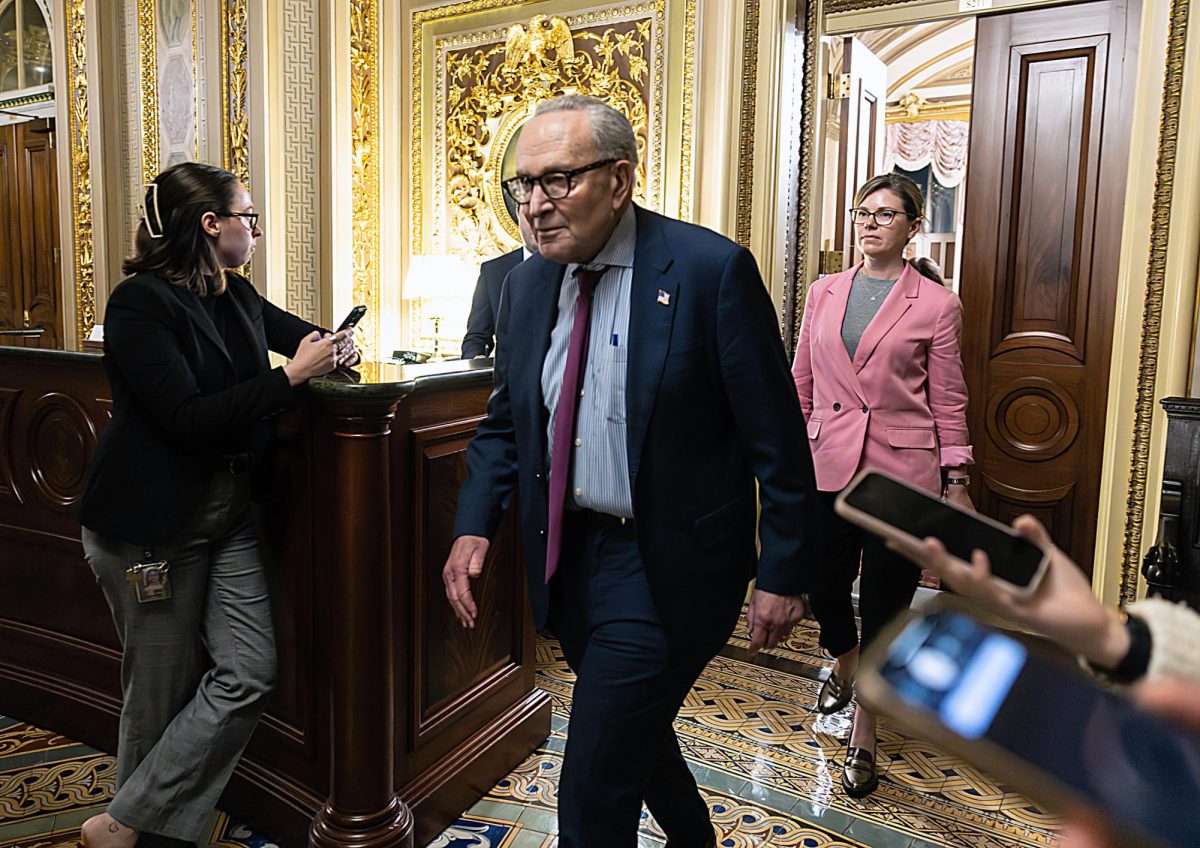
The United States government reopened Nov. 12, ending the longest shutdown on record, as President Trump signed legislation to end the 43-day shutdown. The next funding deadline for most federal agencies is Jan. 30. The House passed the funding after eight senators broke with the Democratic Party Nov. 10, advancing the funding package.
When Congress fails to come to a consensus on how to allocate funds, a budget is unable to be passed, causing government operations to come to a halt. The dispute typically stems from contrasting views between the two major parties on what should be funded. This time is no different.
Following the shutdown and its cause has been a priority for the Hoover AP Government teacher, Mr. Rob Motz.
“The primary cause of this shutdown is that Democrats and Republicans cannot agree on a budget,” he said. “The Democrats want the new budget to restore some healthcare funding that was cut in the ‘Big Beautiful Bill’ that was passed earlier this year. The Republicans are open to negotiating restoring that funding, but want to reopen the government first.”
When a shutdown occurs, funding is paused for almost all government funded projects, harming government employed workers financially.
“[The effect of a shutdown on government employees] depends,” Motz said. “The most severe in this case is that the Trump Administration is attempting to use this shutdown as an opportunity to shrink some government agencies, meaning that some employees could lose their jobs. Many government employees get furloughed, meaning they get sent home without pay but will go back to work once the government reopens. Other essential employees have to come to work without pay. Some active duty soldiers will miss paychecks. These impacts increase in severity the longer the shutdown lasts.”
Lack of operations within the government not only affects workers, but also local communities and families across the U.S. Professor of Economics Lucas Engelhardt is aware of the effects for those not governmentally involved.
“While federal workers are the ones that probably feel the deepest impact — at least temporarily — others do feel impacts, too,” he said. “On Nov. 1, the SNAP program wasn’t able to provide benefits to those who qualify, and there have been reports of a significant number of delayed or cancelled flights. Air traffic controllers have been working without pay since Oct. 1, and the number of absences has been increasing as the shut down [has] gone on.”
The importance of government shutdowns is an ongoing battle, with opinions teetering between the idea of a shutdown being an easy out politically or a necessary time taken away.
“I tend to take the view that shutdowns are kind of like when a labor union goes on strike,” Engelhardt said. “If everyone knew how it would turn out, the strike would never happen — both sides would just make the agreement. That is: the strike itself is unproductive. However, before the strike, neither side knows how much the other is willing to give up. A strike makes refusing to accommodate more expensive the longer it goes on…I think the same thing is happening with the political parties right now. Each is hoping that the shutdown is going to make the other party look bad to the public — and that will make them more willing to give up more in the negotiation process. Is it worth it in the end? Probably not — though it might be that one of the parties can use the shutdown for some political advantage.”
Motz shares a similar opinion; he believes Congress focuses on their differences so much that it affects their constituents.
“Shutdowns are the result of failures of leadership on both sides of the aisle,” he said. “There is damage being done because Congress fails year after year to produce a budget on time. Ultimately, we have to hold Congress accountable in elections if they can’t do their job.”
Moving forward, many think changes need to be made to avoid future shutdowns, including Engelhardt.
“Personally, I’d like for us to reconsider the annual budgeting process,” he said. “If a program is intended to be permanent (or at least to last until some specific change in law), then treat it like the mandatory spending. The only programs that should require regular legal action to keep going are those that are actually intended to be temporary. Dividing programs in this way allows for anyone impacted to make more accurate plans compared to the annual budgeting process.”