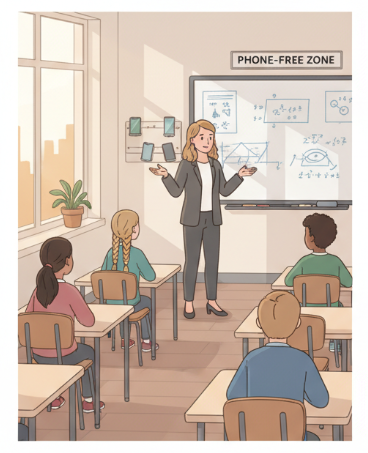
On Jan. 1, 2026 the initiation of House Bill 250, a new law requiring that every school district in Ohio must establish an official cellphone policy, came into effect, limiting cell phone usage in schools of all grade levels.
Within North Canton City Schools (NCCS), this law mainly affects Hoover High School (HHS), as high school students make up over 50% of the total number of students who are addicted to their cell phones. With this new legislation in place, administrators hope for there to be positive changes made in the classroom.
“The House Bill 250 is supposed to reduce distractions, improve academic focus, increase engagement and protect the learning time,” Mr. Henry Householder, Hoover’s head principal said.
This rule originated back in May 2024 when Governor Mike DeWine signed it into law, including in the process one of our own Ohio senators, Mrs. Jane Timken. She explains that the formation of this law wasn’t because of one singular action but rather a continuation of data gathered over a long period of time.
“I really think it’s the research in the literature that shows increased cell phone usage among young children and teenagers has increased anxiety, depression and self harm,” Timken said.
In regards to mental health, school counselors are also expecting there to be a visible change in students, only in a different light than teachers do. Mrs. Amy Myers, HHS counselor, feels slightly nervous for teenagers at Hoover to have to go the full school day without their phone considering that they are “so accustomed to having [phones] on them.”
“I do worry that [for] students, it will take them a while to adjust to this new expectation, because it’s so different [from] what they’ve been asked to do or been expected to do [up until] now,” Myers said. “In classrooms today, they’re not expected to have their phones out, unless it is for educational purposes.”
Mrs. Myers also knows that cell phones are an “integral part of their existence” and that they “don’t know how to exist without it.”
The law went into effect as soon as the clock struck midnight on January 1, 2026. Although it started almost halfway through the school year, some districts decided to start enforcing their policy in August.
“We chose to wait [until January 1], because we were waiting on the guidance to come from the Ohio Department of Education, so that we didn’t [need to] make a new policy and then change it three months into it,” Mr. Tim Walker, NCCS Superintendent, said.
While the NCCS district’s administration decided to wait to enforce the new legislation, teachers could decide whether or not they wanted to start “practicing” before then.
“I’m not sure if all students in the building know, but the science department has been piloting this and so what I have heard is that the effects on student performance, their academics as a whole and their ability to pay attention has been extremely positive without the phones,” Myers said. “So I hope that that translates into all subject areas for all of our students, and I hope all of our teachers can share back and report a great improvement in students’ focus, their ability to attend to the content that’s happening in front of them and the lesson in front of them. I hope it brings about more engagement between peers, and I hope it helps students put their tech use into healthier perspectives and parameters.”
Not only has there been positive feedback from Hoover, but also throughout the state.
“We’ve already started to see some evidence of academic improvements in places that have banned cell phones, and I have heard from many teachers and superintendents that it’s made a significant difference already in the school,” Timken said.
Whether or not students feel prepared to make this drastic change in their school lives, there’s no choice but to try. And although there’s not much of a difference between what the phone policy was for students in middle school and what it is now at HHS, the challenges will remain the same.
“So I think for some students, that [it] is just a radical, wild adjustment that we are expecting our young people to just do and I think it’s going to be a challenge for a number of them, but I also think our lived experiences as we go into the 2026 new year, and [the fact that] we’re all doing this together, will be powerful and teach us a lot about if this is something that we can do,” Myers said.
The specifics behind House Bill 250 are that the phone policy goes from bell to bell, 7:20 in the morning to 2:20 in the afternoon. Regarding where they are to be held during that time, that’s up to teacher discretion, but the one rule is that they must be out of sight.
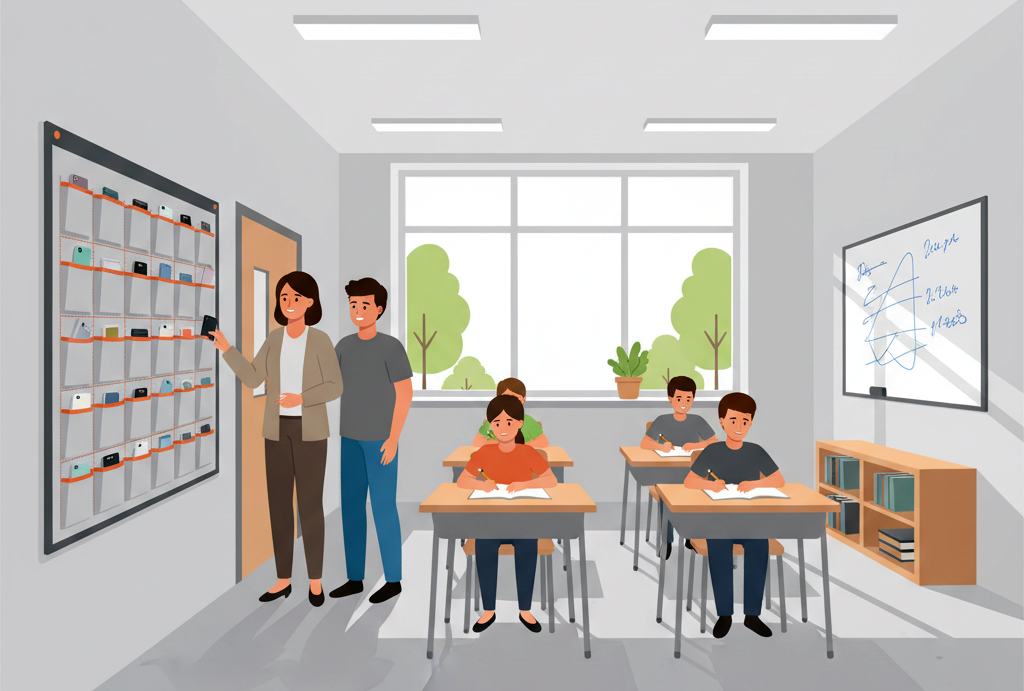
Mr. Householder has noticed that many of the teachers like to use caddies in their classrooms because they’ve been successful, so the school “went ahead and got any teacher [one] who wanted [to use] it in their classroom.” Although it is an option, it’s not the only option as it is up to the teacher if they want to use a caddie or if keeping them out of sight is good enough.
“They can decide if every kid puts their cell phone in their backpack,” Timken said. “They can put them in pouches. They can put them in baskets on the teacher’s desk. Every school can make their determination, but there are exceptions for students that need their cell phone for health monitoring, and many students who are diabetic use their phones to monitor their glucose levels. Each school is to come up with a policy, and if there is an incident or emergency, students can have access to their phones.”
In addition to there being exceptions for students that need their phones for medical reasons, there are also exceptions for students who use it for a class with teacher approval as well as students who have “specific learning needs that they may be allowed to use [their cell phones], as well as some of our Mother Tongue-Based Multilingual Education (MLE) students that use that actively to translate” as Mr. Householder explained.
If a student gets caught using their phone without one of these exceptions, teachers have been taught how to move forward while trying to cause the least amount of distraction possible.
“…[It] is going to be them contacting the office, and one of the administrators, or Mr. Sarbaugh, coming to retrieve the phone, then the student coming down to the office at the end of that class, because we don’t want to take away instructional time,” Householder said. “If it’s a study hall, they can come right back.”
With House Bill 250, both students and teachers are going to have to learn to change what they’ve been doing daily for years and as Mrs. Myers said, “It takes a lot of practice and time, and I think some kids will be okay with it, and some kids will struggle.”
“But I think overall, for the purpose of ensuring students receive a quality education, this is a really great step to implement for all schools in Ohio, public, private or whatever, because we know how distracting that can be,” Myers said. “We know how it can steal our attention.”
If students find the start of the new year to be extra challenging, more so than others, because of the new legislation, there are support systems at Hoover to help them along the way and just make it through the last few months of this school year.
“…If someone’s struggling, no matter what we are, our doors are open to help process and look at things in healthier ways,” Myers said.

![Ariel [Hoover freshman Emma Mead] attempts to sing without her voice in North Canton Playhouse’s production of “The Little Mermaid.”](https://thevikingviews.com/wp-content/uploads/2026/03/IMG_4945-1200x800.jpg)

![[from left] Freshman Austin Weaver, senior Carys Eynon, senior Andy Reynolds, and junior Nolan Pellegrino journey on the Yellow Brick Road towards the Emerald City.](https://thevikingviews.com/wp-content/uploads/2026/03/2025_Wizard-of-Oz_Web-274-1200x800.jpg)